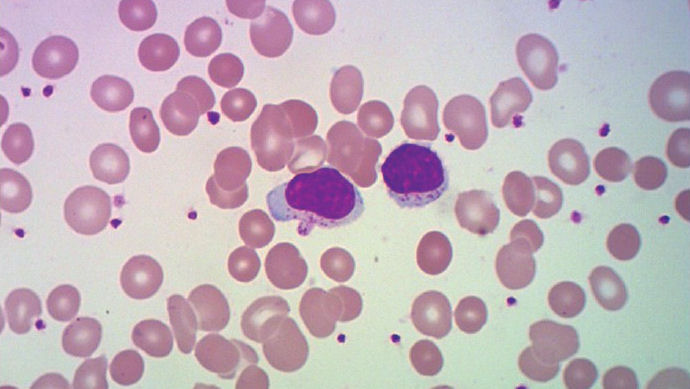
Amasing histology slide
Original image:
Good morning
Source: Facebook via Trust me I´m a "Medical Technologist"
Art and Science of Laboratory Medicine. Clinical laboratory and biomedical science related news, abstracts and images for medical laboratory professionals, students and other laboratory geeks.
Art and Science of Laboratory Medicine
Sunday, December 4, 2016
The Never-ending Mannequin Challenge
Every day is a mannequin challenge for ALS patients.
View in YouTube:
The never-ending Mannequin Challenge
Source: YouTube
View in YouTube:
The never-ending Mannequin Challenge
Source: YouTube
Missing Link in Malaria Evolution Discovered in Historical Specimens
A family’s collection of antique microscope slides became a trove of genetic information about the eradicated European malaria pathogen. These slides of stained blood droplets date to the 1940s and contain strains of the malaria parasite that are now extinct (image).
Lalueza-Fox and his colleagues were left with the first genetic material of extinct European Plasmodium species ever studied. They recovered DNA from both P. falciparum, the predominant species in Africa and the species responsible for the majority of today’s malaria deaths, and P. vivax, a less virulent species found widely across the globe. Scientists have long debated how P. vivax arrived in the Americas, with one theory suggesting colonial Europeans brought the pathogen over, while another posits entry from the other direction, when early humans crossed the Bering Land Bridge from Asia. The two theories, notes Jane Carlton, a malaria researcher at New York University who was not involved in the study, are not necessarily mutually exclusive.
The extinct European P. vivax genome more closely resembled strains found today in South America than those found in East Asia, lending credibility to the theory of a more recent introduction by European colonists. The European P. falciparum genome, however, was starkly divergent from the modern South American subtype, supporting the theory that this more-deadly species came to South America directly from Africa during the slave trade.
Read more:
Missing Link in Malaria Evolution Discovered in Historical Specimens
Source: The Scientist Magazine®
Image: Charles Aranda
Lalueza-Fox and his colleagues were left with the first genetic material of extinct European Plasmodium species ever studied. They recovered DNA from both P. falciparum, the predominant species in Africa and the species responsible for the majority of today’s malaria deaths, and P. vivax, a less virulent species found widely across the globe. Scientists have long debated how P. vivax arrived in the Americas, with one theory suggesting colonial Europeans brought the pathogen over, while another posits entry from the other direction, when early humans crossed the Bering Land Bridge from Asia. The two theories, notes Jane Carlton, a malaria researcher at New York University who was not involved in the study, are not necessarily mutually exclusive.
The extinct European P. vivax genome more closely resembled strains found today in South America than those found in East Asia, lending credibility to the theory of a more recent introduction by European colonists. The European P. falciparum genome, however, was starkly divergent from the modern South American subtype, supporting the theory that this more-deadly species came to South America directly from Africa during the slave trade.
Read more:
Missing Link in Malaria Evolution Discovered in Historical Specimens
Source: The Scientist Magazine®Image: Charles Aranda
Saturday, December 3, 2016
Cat people have meowcytes in their blood
Peripheral blood cell morphology. Meowcyte by Theresa Gonzales
Source: Facebook via Theresa Gonzalez
Where to test HIV or Hepatitis? - European Test Finder
Almost every second person (47%) diagnosed in 2014 was a late presenter or with indication of advanced infection. This means that these individuals are only diagnosed when their immune system already starts to fail. Providing antiretroviral therapy at the early stages of HIV infection allows people with HIV to live longer and healthier lives, and reduces the risk of transmitting HIV to others.
With the newly created and mobile-optimised European Test Finder, it only takes a few seconds to locate a testing site near you – wherever you are in Europe.
Open search engine here:
European test finder
Source: ECDC
With the newly created and mobile-optimised European Test Finder, it only takes a few seconds to locate a testing site near you – wherever you are in Europe.
Open search engine here:
European test finder
Source: ECDC
Hospital command center
The people who manage patient flow at hospitals might like a crystal ball that shows them when their resources are about to be overwhelmed. Hospitals are trying out what might be the next best thing. They're wiring command centers with monitors that display predictive analytics fueled by every conceivable data source that gives a glimpse of a patient's movement through the facility.
Taking a cue from other industries that assemble command centers to manage complex logistics, GE Healthcare equipped Johns Hopkins with the company's first Wall of Analytics, which features 22 information screens that can pull data from 14 sources, including the electronic health record, admission software and OR scheduling applications. GE is working with a handful of other hospitals to deploy the technology.
Although the command center at Johns Hopkins has been up and running for less than a year, the hospital has seen a 30% reduction in ER patients who have to wait for an inpatient bed and a roughly 70% reduction in patients who must be held in the OR because there's no recovery or inpatient bed for them, according to Jim Scheulen, Johns Hopkins Hospital's chief administrative officer for emergency medicine and capacity management.
Read more:
Hospital command centers help manage flow
Source: Modern Healthcare Modern Healthcare business news
Taking a cue from other industries that assemble command centers to manage complex logistics, GE Healthcare equipped Johns Hopkins with the company's first Wall of Analytics, which features 22 information screens that can pull data from 14 sources, including the electronic health record, admission software and OR scheduling applications. GE is working with a handful of other hospitals to deploy the technology.
Although the command center at Johns Hopkins has been up and running for less than a year, the hospital has seen a 30% reduction in ER patients who have to wait for an inpatient bed and a roughly 70% reduction in patients who must be held in the OR because there's no recovery or inpatient bed for them, according to Jim Scheulen, Johns Hopkins Hospital's chief administrative officer for emergency medicine and capacity management.
Read more:
Hospital command centers help manage flow
Source: Modern Healthcare Modern Healthcare business news
Friday, December 2, 2016
New method to restore function of white blood cells in septic patients
New research findings published in the Journal of Leukocyte Biology, suggest that treating the white blood cells of sepsis patients with antibodies that block programmed cell death-1 (PD-1) and programmed cell death ligand (PD-L1) molecules may restore their function and ultimately their ability to eradicate deadly bacteria.
"We hope that this study will lead to a better understanding of why patients with sepsis are often unable to successfully eradicate invading microorganisms," said author Andriani C. Patera, Ph.D. "Furthermore, we hope that this study will stimulate new therapies to treat sepsis based on stimulating various components of the immune system."
Read more:
Scientists discover new method to restore function of white blood cells in septic patients
Source: EurekAlert! Science News
"We hope that this study will lead to a better understanding of why patients with sepsis are often unable to successfully eradicate invading microorganisms," said author Andriani C. Patera, Ph.D. "Furthermore, we hope that this study will stimulate new therapies to treat sepsis based on stimulating various components of the immune system."
Read more:
Scientists discover new method to restore function of white blood cells in septic patients
Source: EurekAlert! Science News
Subscribe to:
Posts (Atom)