
Art and Science of Laboratory Medicine

Friday, December 30, 2016
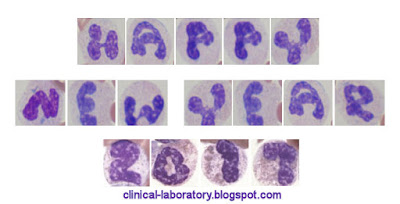
Happy New Year 2017
I wish a beautiful and successful New Year 2017 to all medical laboratory professionals.
Can you make a perfect blood smear?
A well-made blood smear is a beauty to behold, and likely to yield significant information. A poor slide is a torment. Here, the methods for making and stainingsmears are given
 Blood films made on slides. (A) A well-made film. (B) An irregular patchy film on a dusty slide. (C) A film that is too thick. (D) A film that has been spread with inconsistent pressure and using an irregularly edged spreader, resulting in long tails. (E) A film made on a very greasy slide.
Wedge slide technique for preparation of a peripheral blood smear


Source: uvm.edu

Wedge slide technique for preparation of a peripheral blood smear
Source: uvm.edu
Thursday, December 29, 2016
Red cell landscape architecture in Hamburg
Like the capillaries of a blood vessel system, the green well valleys pass through the area. In them, Birgitta Weimer places her 'globules', red blood cells. The red lacquered globules are an abstraction of red blood cells in 200,000-fold magnification.
Read moe:
IGS Hamburg 2013 | Terramanus Landschaftsarchitektur
 Source: Terramanus
Read moe:
IGS Hamburg 2013 | Terramanus Landschaftsarchitektur


The challenge of preventing overdiagnosis
Death itself comes to be regarded as a failure of medicine and doctors, rather than the inevitable culmination of every life.
Over the past several decades, the economic interests of the pharmaceutical and medical technology industries have both pressured and tempted medicine to overextend itself. The traditional moral commitment of the medical profession to relieve suffering and to care for the dying has been gradually displaced by a futile and misguided attempt to solve humanity’s most profound existential problems through biotechnical means. Doctors now apply more and more powerful treatments towards the end of life and try to prevent diseases by seeking out and correcting more and more risk factors. All this has led to an epidemic of overdiagnosis and overtreatment affecting us all, but perhaps particularly harming the old.
Doctors and other health professionals are gradually beginning to understand that they may now find themselves in the unfortunate position of doing harm while trying to do good; academic researchers are working to investigate the extent and effects of overdiagnosis, and how it might be mitigated; and journalists and policy-makers seem finally to be beginning to take the issue seriously by promoting greater public debate.
Read more:
The challenge of preventing overdiagnosis
 Source: CMAJ Blogs
Over the past several decades, the economic interests of the pharmaceutical and medical technology industries have both pressured and tempted medicine to overextend itself. The traditional moral commitment of the medical profession to relieve suffering and to care for the dying has been gradually displaced by a futile and misguided attempt to solve humanity’s most profound existential problems through biotechnical means. Doctors now apply more and more powerful treatments towards the end of life and try to prevent diseases by seeking out and correcting more and more risk factors. All this has led to an epidemic of overdiagnosis and overtreatment affecting us all, but perhaps particularly harming the old.
Doctors and other health professionals are gradually beginning to understand that they may now find themselves in the unfortunate position of doing harm while trying to do good; academic researchers are working to investigate the extent and effects of overdiagnosis, and how it might be mitigated; and journalists and policy-makers seem finally to be beginning to take the issue seriously by promoting greater public debate.
Read more:
The challenge of preventing overdiagnosis

Wednesday, December 28, 2016
Case studies of blood draw
Most phlebotomists don’t think that a venipuncture can land them in the witness chair desperately defending their technique; most phlebotomy supervisors don’t realize they can be called as the next witness to defend their hiring and training practices. In today’s litigious society, it would be easy to discount phlebotomy-related lawsuits as the frivolous pursuit of ill-gotten gains. Many patients, however, are suffering and suing with just cause.
Phlebotomy is one of the most underestimated procedures in health care. It’s a heavily detailed invasive procedure requiring the collector to perform a complex sequence of maneuvers to be performed properly and safely.
Labortory Manager Magazine has collected 12 interesting case studies of phlebotomy and related legal issues.
Read more:
Phlebotomy Meets The Law
 Source: Laboratory Manager
Phlebotomy is one of the most underestimated procedures in health care. It’s a heavily detailed invasive procedure requiring the collector to perform a complex sequence of maneuvers to be performed properly and safely.
Labortory Manager Magazine has collected 12 interesting case studies of phlebotomy and related legal issues.
Read more:
Phlebotomy Meets The Law

Tuesday, December 27, 2016
First genetically-modified human embryos could be created in Britain
The first genetically-modified human embryos could be created in Britain within weeks according to the scientists who are about to learn whether their research proposal has been approved by the fertility watchdog.
Although it will be illegal to allow the embryos to live beyond 14 days, and be implanted into the womb, the researchers accepted that the research could one day lead to the birth of the first GM babies should the existing ban be lifted for medical reasons.
A licence application to edit the genes of “spare” IVF embryos for research purposes only is to be discussed on 14 January by the Human Fertilisation and Embryology Authority (HFEA), with final approval likely to be given this month.
Read more:
IVF: First genetically-modified human embryos 'could be created in Britain within weeks'
 Source: The Independent
Although it will be illegal to allow the embryos to live beyond 14 days, and be implanted into the womb, the researchers accepted that the research could one day lead to the birth of the first GM babies should the existing ban be lifted for medical reasons.
A licence application to edit the genes of “spare” IVF embryos for research purposes only is to be discussed on 14 January by the Human Fertilisation and Embryology Authority (HFEA), with final approval likely to be given this month.
Read more:
IVF: First genetically-modified human embryos 'could be created in Britain within weeks'

Subscribe to:
Posts (Atom)
Follow "Art and Science of Laboratory Medicine " on:
 |  |  |  |  |  |